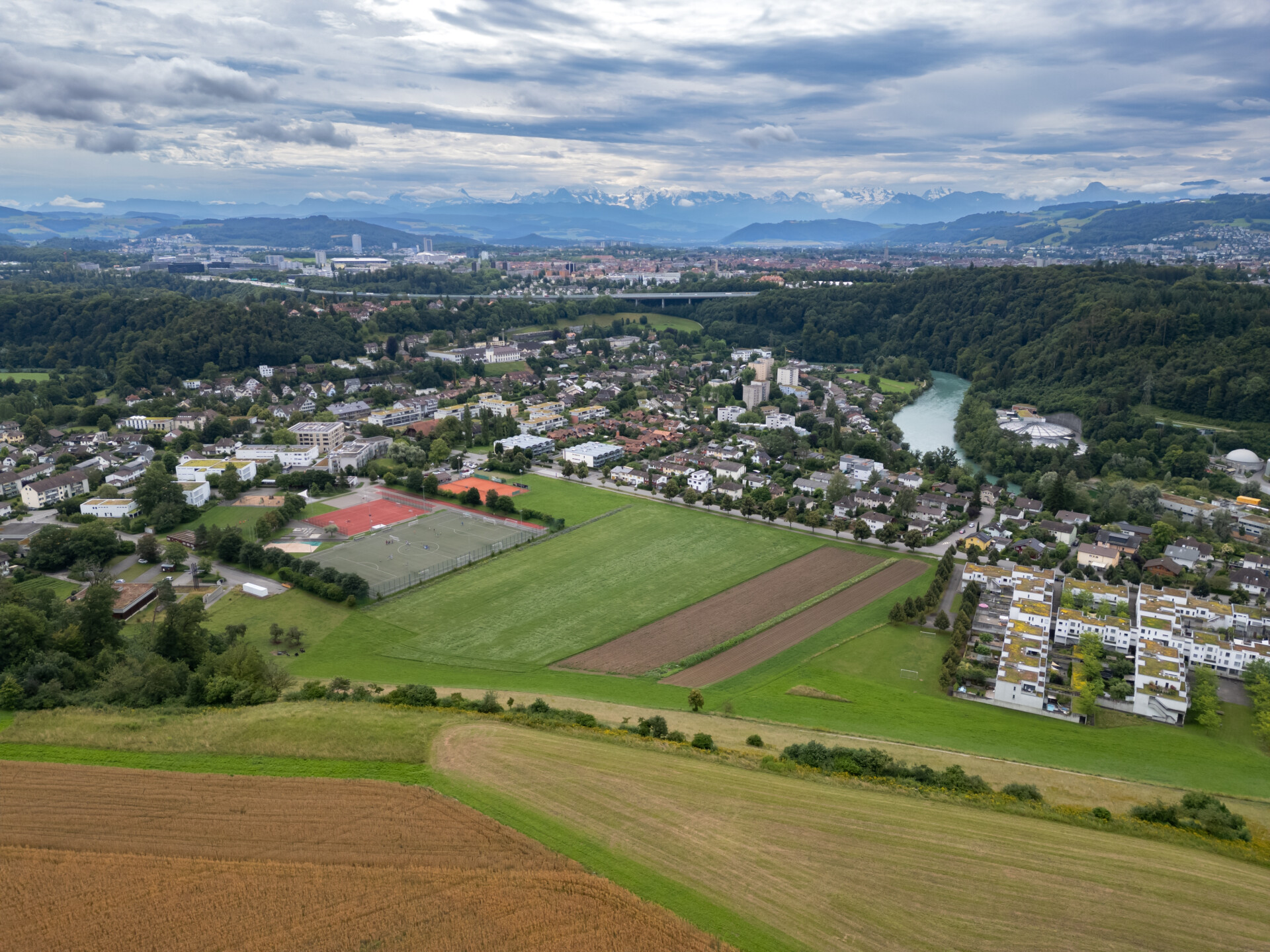
Bremgarten near Bern: Equipped with the strategic tools to achieve net-zero
For more than 40 years, the municipality of Bremgarten near Bern has been committed to sustainable climate and energy policies – whether as a pioneer in the use of wastewater heat from the Bern Region Wastewater Treatment Plant in the Bremgarten heating network, or as an Energy City with a wide range of successfully implemented measures.
Since 2018, Swiss Climate has been supporting the municipality as part of the Energy City advisory service and has assisted it on its path to two successful recertifications – most recently in 2024 with an outstanding result of 73.4 per cent.
Over the course of this long-standing collaboration, various significant projects have been realised together, including the drafting of a regulation for the funding programme, a PV feasibility study, and greenhouse gas inventories for the municipal area and the municipal administration.
By developing an energy and climate strategy, Bremgarten bei Bern 2025 has also laid the long-term strategic foundations for achieving the net-zero target in a focused and effective manner.
Approach to the development
The development of the energy and climate strategy took place through a structured process that built on existing foundations and previous work within the framework of Energy City, and was guided by the Federal Office for the Environment’s guidelines for municipal climate strategies. At the same time, it was ensured that the requirements for cantonal funding under the Climate Programme for Municipalities were taken into account throughout the process.
The development process was divided into three key phases, which are briefly explained below.
Step 1: Situation analysis
Initially, the baseline situation of the municipality of Bremgarten near Bern was comprehensively analysed. The focus was on heat supply, energy consumption and greenhouse gas emissions within the municipal area and the municipal administration. In addition, a risk analysis of the impacts of climate change was carried out.
In parallel, the relevant stakeholders were identified. Building on this, the project team assessed the need for action in the various municipal areas of intervention, for example in the sectors of buildings and energy supply, mobility, and consumption and the circular economy. The situation analysis formed the technical basis for the subsequent strategy development.
Step 2: Target development and action plan
Based on the situation analysis, a workshop was held to define the relevant areas of action and the priority directions in the fields of climate protection, adaptation to climate change and the municipal administration’s role as a role model.
Subsequently, taking into account the analysis results as well as the overarching national and regional framework conditions, net-zero targets and corresponding reduction pathways were established for the municipal area and the local authority. A qualitative target was additionally defined for climate change adaptation.
Building on this, existing measures were compiled and supplemented with additional measures to close identified gaps in the targets. In a participatory workshop with representatives of local political parties, Swiss Climate discussed and prioritised the proposed measures together with the stakeholders.
The resulting action plan defines the priority measures for the next four years. In addition, an estimate was made of the expected emission reductions up to the net-zero target year.
Step 3: Anchoring
In the final step, the strategy was anchored politically and administratively within the municipality.
To this end, an initial assessment was made of the financial resources required to ensure the implementation of the planned measures. At the same time, a monitoring system was developed to regularly review progress towards the targets and adjust the strategy where necessary.
The municipal council adopted the energy and climate strategy and integrated it into the municipality’s ongoing planning and decision-making processes. Responsibilities were clearly assigned and the necessary resources were firmly established.
Finally, the strategy was communicated both internally and externally to foster transparency and acceptance and to ensure sustainable implementation in the day-to-day running of the municipality.
“Together with Swiss Climate, we are developing an energy and climate strategy and are able to benefit from their extensive expertise in the fields of energy, climate protection and climate change adaptation. We can build on a solid foundation: last year, Swiss Climate supported us in updating the greenhouse gas accounting for the municipal area and in conducting the first-ever accounting of greenhouse gas emissions from the municipal administration. A key focus of the energy and climate strategy is also the spatial analysis of heat supply, where we can likewise rely on the expertise of the Swiss Climate team.”
Peter Bangerter, Municipal Administrator, Bremgarten near Bern
The following services were provided by Swiss Climate for this project:
- Greenhouse gas accounting of the municipal area and the municipal administration
- Development of an energy and climate strategy
- Spatial analysis of heat supply and recommendations for further development
- Participatory development of measures